TEE Probe Repair: Common Failures, Repair Options, and Replacement Considerations


Can a Damaged TEE Probe Be Repaired?

Many transesophageal echocardiography (TEE) probe failures can be repaired, including bending rubber damage, articulation problems, physical damage, cable failures, and internal electronic faults. Repairability depends on the probe model, extent of damage, component availability, and ability to meet applicable safety and performance requirements after service.

TEE probes combine miniature imaging electronics, mechanical articulation systems, and a flexible insertion tube within a device that must withstand repeated clinical use and high-level disinfection. Damage affecting one component may extend to others, making accurate diagnosis particularly important.

Replacing a TEE probe can cost $20,000 to $40,000, depending on the model. Innovatus Imaging brings more than 40 years of OEM manufacturing experience and over 50,000 TEE probe repairs to the evaluation and restoration of these complex devices. Its repair processes focus on identifying underlying failures, replacing affected components where appropriate, and verifying performance before returning the probe to service.
Common TEE Probe Failures and What They Indicate


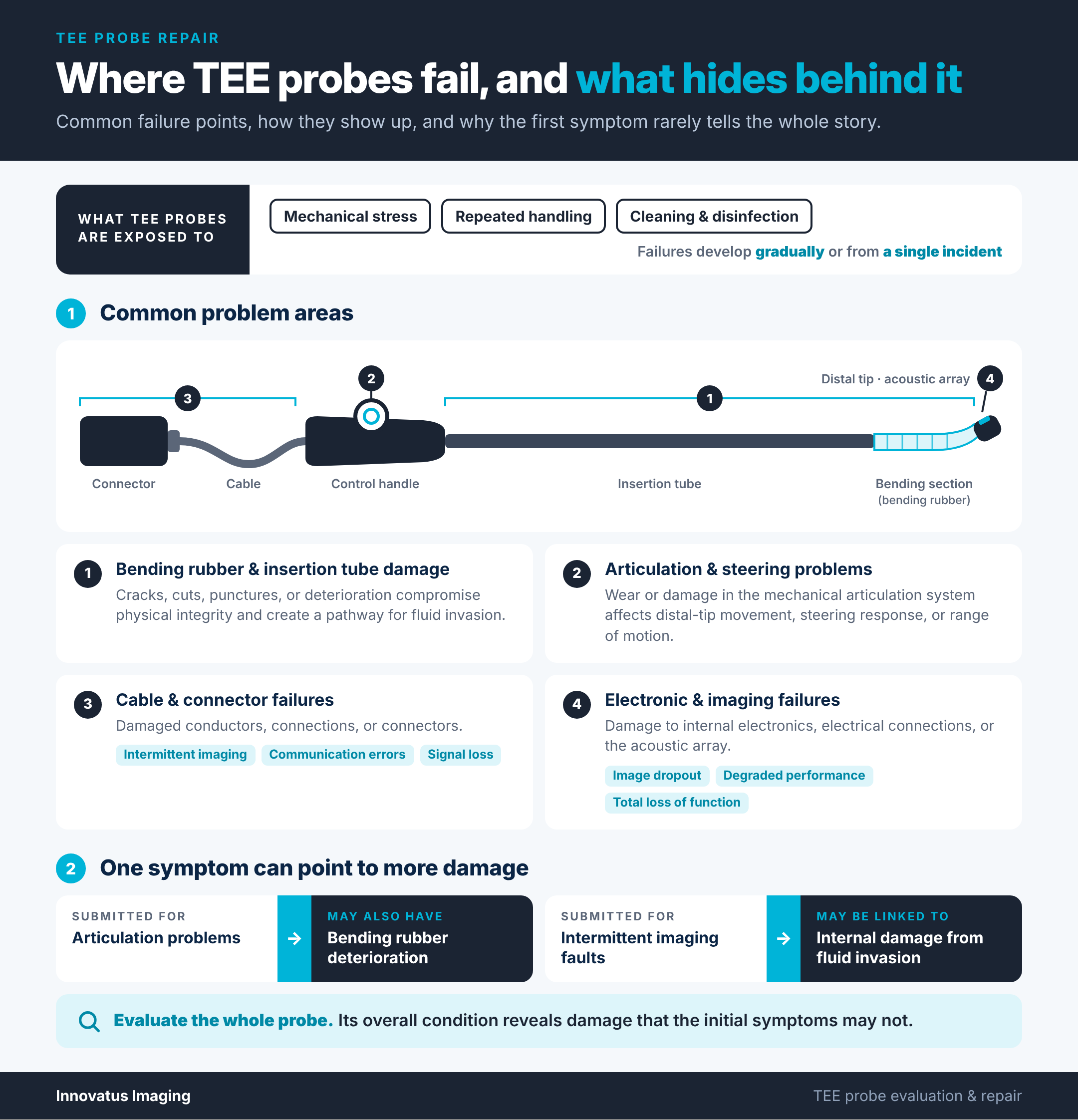
TEE probes are exposed to mechanical stress, repeated handling, and cleaning and disinfection processes. Failures may develop gradually or result from a single incident.

Common problems include:

  • Bending rubber and insertion tube damage: Cracks, cuts, punctures, or deterioration can compromise the probe's physical integrity and create a pathway for fluid invasion.
  • Articulation and steering problems: Wear or damage within the mechanical articulation system can affect distal-tip movement, steering response, or range of motion.
  • Cable and connector failures: Damaged conductors, connections, or connectors may cause intermittent imaging problems, communication errors, or signal loss.
  • Electronic and imaging failures: Damage to internal electronics, electrical connections, or the acoustic array may result in image dropout, degraded performance, or complete loss of functionality.
TEE Probe Failures

A probe submitted for articulation problems may also have deterioration in its bending rubber. Similarly, intermittent imaging faults may be associated with internal damage from fluid invasion.

Evaluating the probe's overall condition helps identify damage that may not be apparent from the initial symptoms.

For more information about TEE probe construction and operation, read TEE Probe 101.

TEE Probe Fluid Invasion: Repair Options and Limitations

Can a Fluid-Invaded TEE Probe Be Repaired?

Some fluid-invaded TEE probes can be repaired when damaged components can be identified and replaced and the probe can meet applicable safety and performance requirements. The extent of internal damage determines whether restoration is feasible.


Fluid invasion can occur when bending rubber, insertion tube materials, seals, or other protective barriers become compromised.


Fluid invasion can damage electrical connections, imaging electronics, and other internal components, sometimes beyond what is visible during external inspection. Removing moisture alone does not necessarily resolve that damage.


Innovatus Imaging's approach emphasizes identifying and replacing affected components where technically feasible, rather than relying solely on drying the assembly to restore immediate operation.


Repair must address the underlying damage and restore applicable electrical safety, physical integrity, and imaging performance requirements before the probe returns to clinical service.

Philips X8-2t, X7-2t, GE 6VT-D, and Siemens Z6M Repair

Innovatus Imaging supports advanced volumetric TEE probes, including the Philips X8-2t, X7-2t, and GE 6VT-D. Their complex imaging arrays, mechanical articulation systems, and internal electronics require specialized diagnostic and repair procedures.

Innovatus applies established repair processes, specialized tooling, and component-level restoration capabilities to evaluate damage and determine whether repair is feasible.

Repair options depend on the specific failure, probe condition, and ability to meet applicable performance requirements.

For qualifying Philips X8-2t probes, Innovatus offers RapidRepair services with turnaround as fast as two business days, depending on the repair requirements.

TEE Probe Repair Versus Replacement: Cost, Turnaround, and Warranty

TEE probe repair can cost substantially less than replacement when damaged components are serviceable. However, the lowest initial repair price does not necessarily provide the best overall value.


Healthcare technology management (HTM) teams should consider:

  • Repair scope: Which components will be repaired or replaced, and does the proposed work address all identified damage?
  • Repair feasibility: Can the probe meet applicable safety and performance requirements after service?
  • Turnaround: How long will evaluation and repair take, including shipping?
  • Equipment availability: Is a compatible loaner or exchange probe available to support scheduled procedures?
  • Warranty: What coverage applies to the completed repair, and are any components or failure types excluded?

Innovatus offers loaner and exchange options for supported TEE probe models, helping facilities manage equipment availability during service.


Innovatus provides a 12-month warranty on repaired TEE probes, subject to applicable terms.


Replacement may be necessary when damage cannot be reliably repaired, required components are unavailable, or the probe cannot meet applicable safety and performance requirements.


Learn more about Ultrasound Probe Repair & Loaners.

TEE Probe Safety Testing and Return-to-Service Requirements

TEE probe repair requires attention to both imaging performance and patient safety.

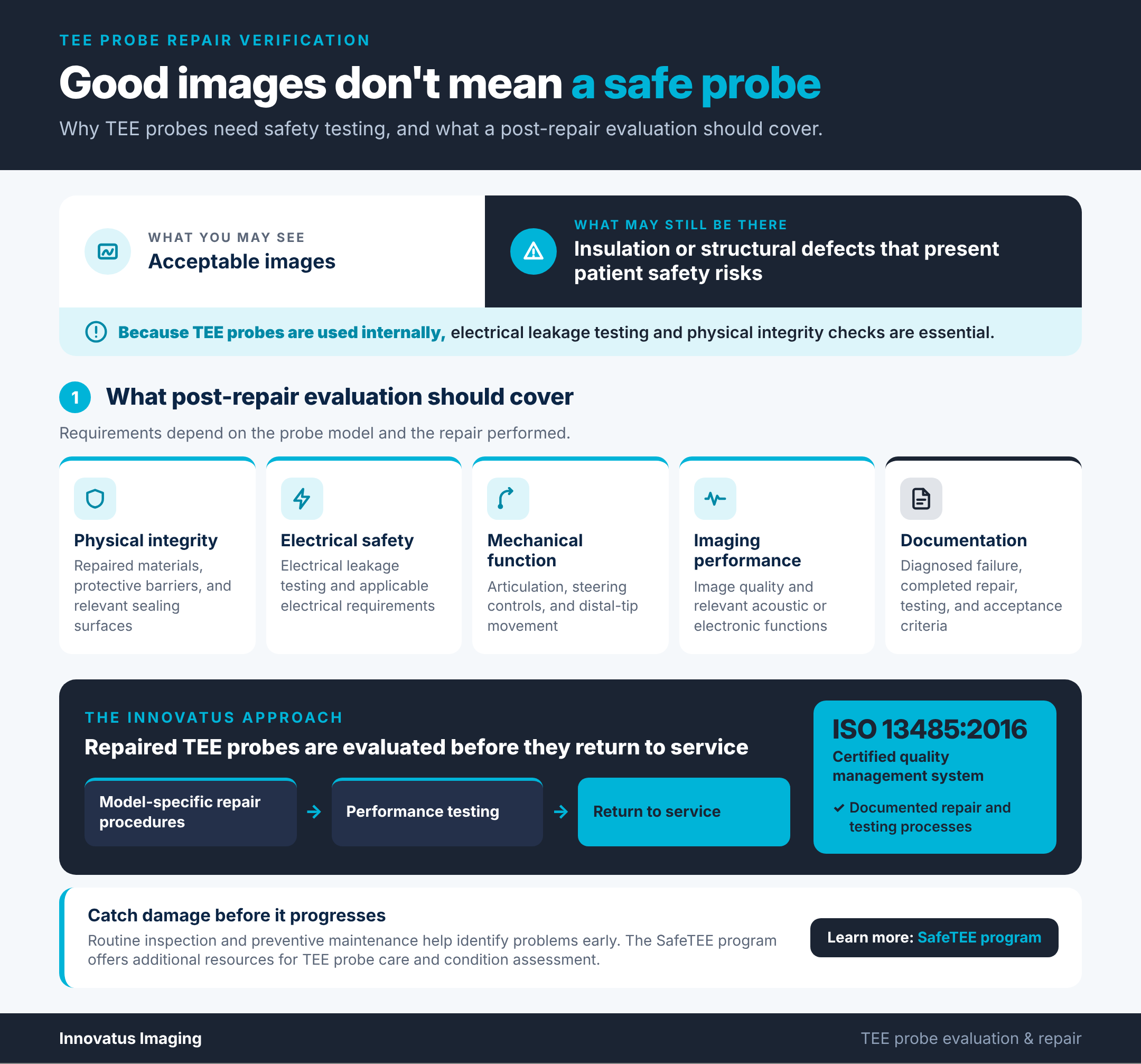
Because TEE probes are used internally, electrical leakage testing and physical integrity checks are essential. A probe may produce acceptable images while still having insulation or structural defects that present patient safety risks.


Post-repair evaluation should address the requirements applicable to the model and repair performed, including:

  • Physical integrity: Inspection of repaired materials, protective barriers, and relevant sealing surfaces.
  • Electrical safety: Appropriate electrical leakage testing and verification of applicable electrical requirements.
  • Mechanical function: Evaluation of articulation, steering controls, and distal-tip movement.
  • Imaging performance: Verification of image quality and relevant acoustic or electronic functions.
  • Documentation: Records of the diagnosed failure, completed repair, testing, and applicable acceptance criteria.

Innovatus uses model-specific repair procedures and performance testing to evaluate repaired TEE probes before return to service.

Its repair operations follow an ISO 13485:2016-certified quality management system, supporting documented repair and testing processes.


Routine inspection and preventive maintenance also help identify damage before it progresses.


Innovatus's SafeTEE program provides additional resources for TEE probe care and condition assessment.

Image

Request a TEE Probe Repair Evaluation

Experiencing a TEE probe failure? Contact Innovatus Imaging for an evaluation of your probe's condition, available repair options, and expected turnaround.

Request a TEE probe evaluation
(opens in a new tab)