Independent Imaging Center Equipment Repair


Managing Costs and Downtime

For an independent imaging center, a failed ultrasound probe or MRI coil can cost considerably more than the repair itself. Lost examination capacity, rescheduled patients, staff disruptions, and replacement expenses can quickly erode operating margins.

For centers with few backup devices, a single failure can disrupt an entire day's schedule.

1. The Real Cost of Lost Examination Capacity

When equipment fails, the financial impact depends on how many examinations are affected and whether those appointments can be recovered.

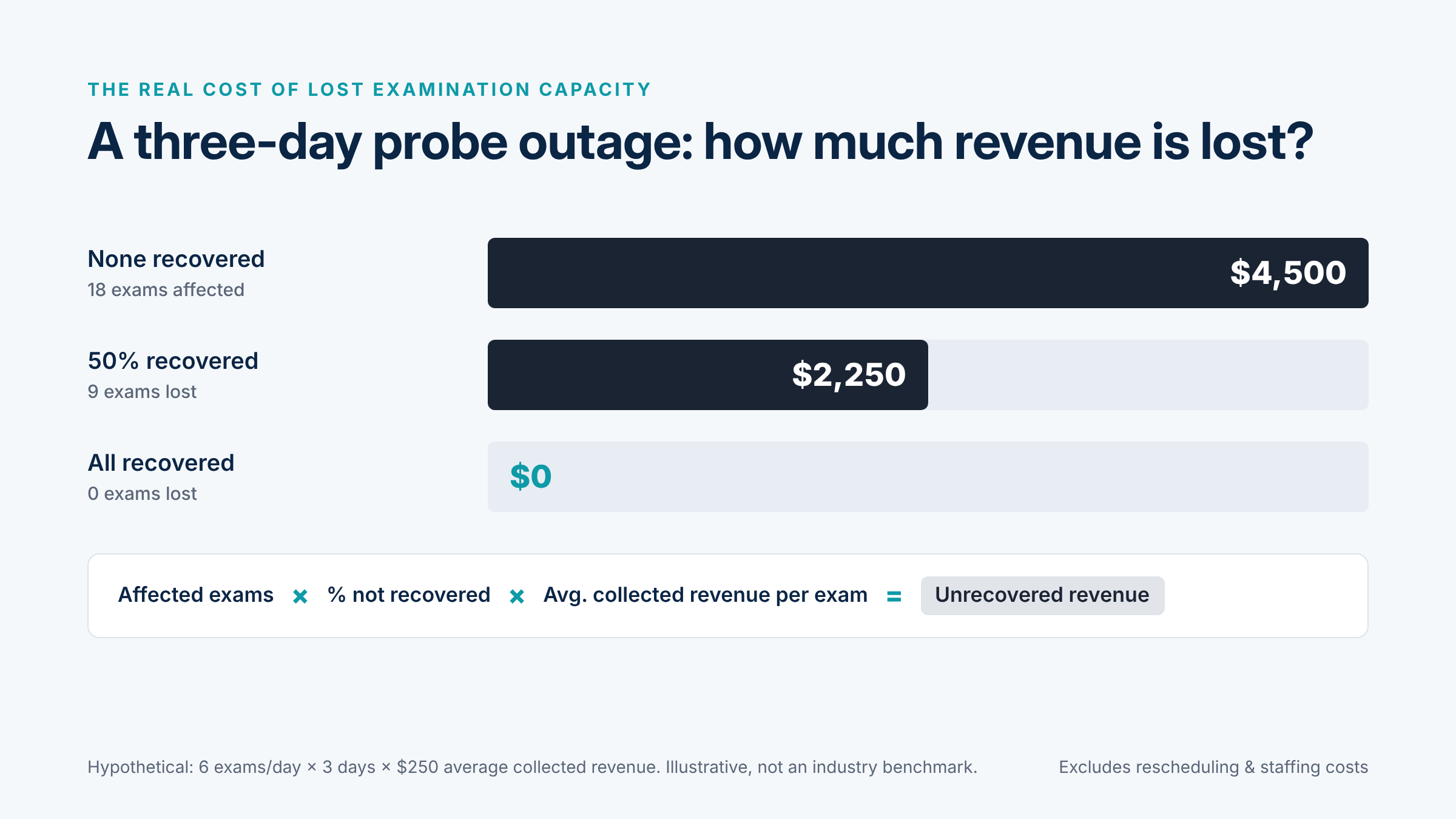
Consider a hypothetical ultrasound imaging center that loses access to a frequently used probe for three days.

Assume the center typically performs six examinations per day using that probe, with an average of $250 in collected revenue per examination.

A graph showing downtime costs

These figures are illustrative, not industry benchmarks. Actual losses depend on reimbursement rates, scheduling flexibility, and the ability to accommodate patients later.

A lower repair estimate may offer little financial advantage if it results in additional days without a critical device. Comparing repair options requires accounting for service costs, shipping, temporary equipment, and examination capacity that cannot be recovered.

2. Repair Economics: When Replacement Isn't Necessary

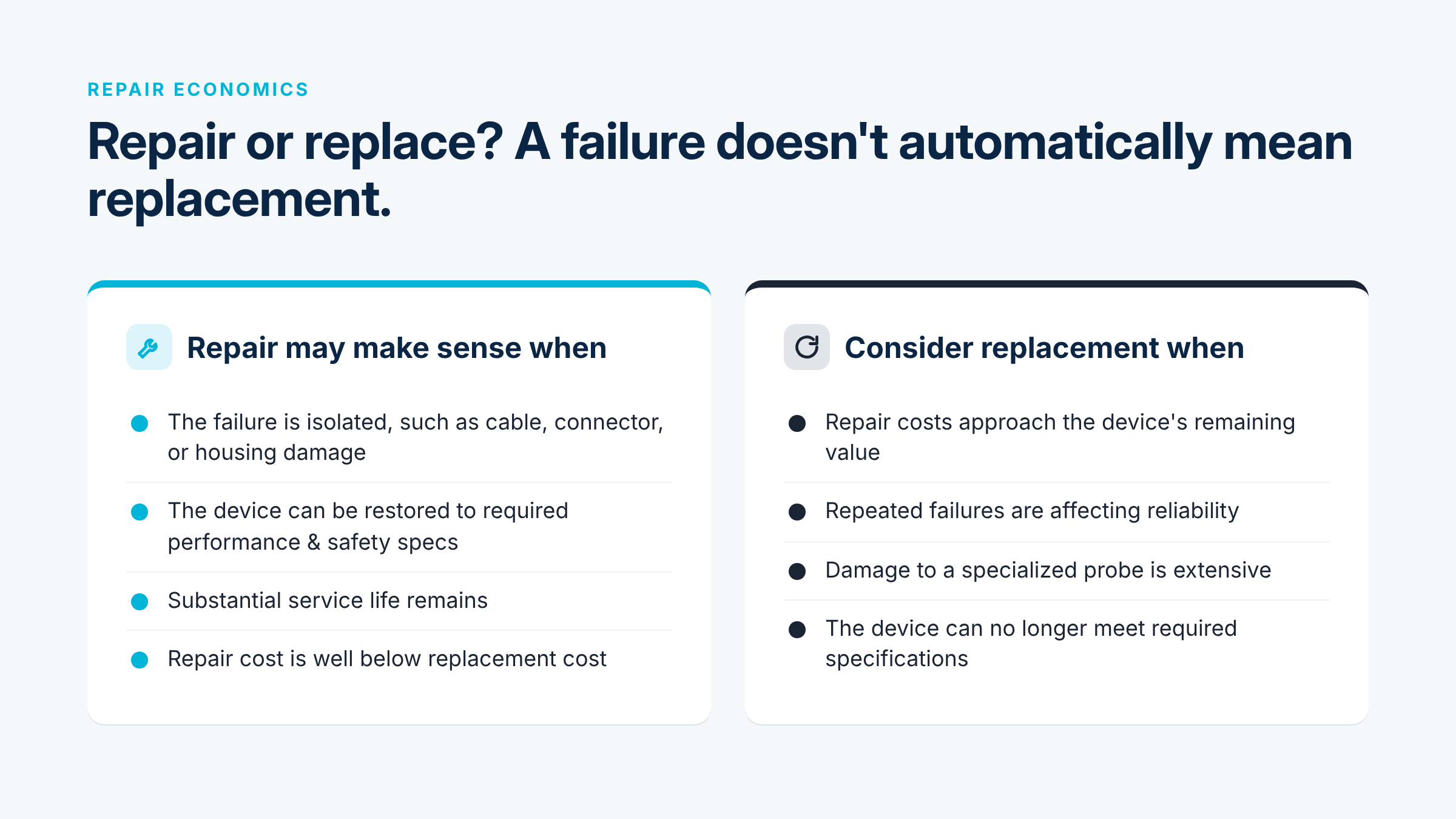
An ultrasound probe or MRI coil failure does not automatically justify replacement. Cable damage, connector failures, housing defects, and certain internal component issues may be repairable, depending on the device model, condition, and extent of the damage.


Before authorizing a replacement, administrators should establish:

  • Whether the damaged device can be restored to required performance and safety specifications.
  • The repair cost relative to replacement.
  • The expected remaining service life of the device.
  • Warranty coverage and the risk of repeat failures.
  • The availability of expedited repair, loaner, or exchange options.

A probe with an isolated cable failure may justify repair. A specialized probe  with extensive damage or recurring failures deserves a closer look at replacement.


Replacement may be the better investment when repair costs approach the device's remaining value, repeated failures affect reliability, or the device can no longer meet required performance specifications.


Innovatus Imaging has completed more than 200,000 ultrasound probe repairs and 50,000 MRI coil repairs, drawing on more than 40 years of specialized engineering and repair experience.


Innovatus maintains in-house engineering, precision machining, rapid prototyping, and component fabrication capabilities, providing greater control over the parts and processes used in qualifying repairs.

Image

3. Loaners, Exchanges, and Appointment Continuity

Independent imaging centers may not have the budget or storage capacity to maintain spare equipment for every scanner and examination type.

A compatible loaner can help maintain scheduled examinations while the original device is repaired. Conventional loaner arrangements generally require the temporary device to be returned once service is complete.

Innovatus Imaging's RapidRestore ultrasound probe exchange program offers another option.

Qualifying ultrasound probes may be exchanged for an available, fully tested finished-goods device. Under the program's approved exchange terms, the center retains the replacement at the quoted repair price of the original probe versus market exchange price.

The damaged probe is returned to Innovatus for restoration and future use.

When an eligible exchange is available, RapidRestore eliminates the wait for the original probe's repair and the additional equipment transition required by a conventional loaner.

Innovatus also offers RapidRepair services and expedited repair options for qualifying ultrasound probes and MRI coils. Availability and turnaround depend on the equipment model, repair requirements, and shipping arrangements.

4. Repair Quality and Repeat Failure Costs

An ultrasound probe submitted with a damaged cable may also have connector wear, housing damage, or other defects affecting its performance.


A comprehensive evaluation can identify these issues before the device is returned to clinical use, reducing the risk of another interruption caused by an undetected problem.


Innovatus's repair process includes detailed device assessment, component-level restoration where appropriate, and performance testing. Its operations follow an ISO 13485-certified quality management system, with repair processes designed to restore applicable OEM form, fit, and function.


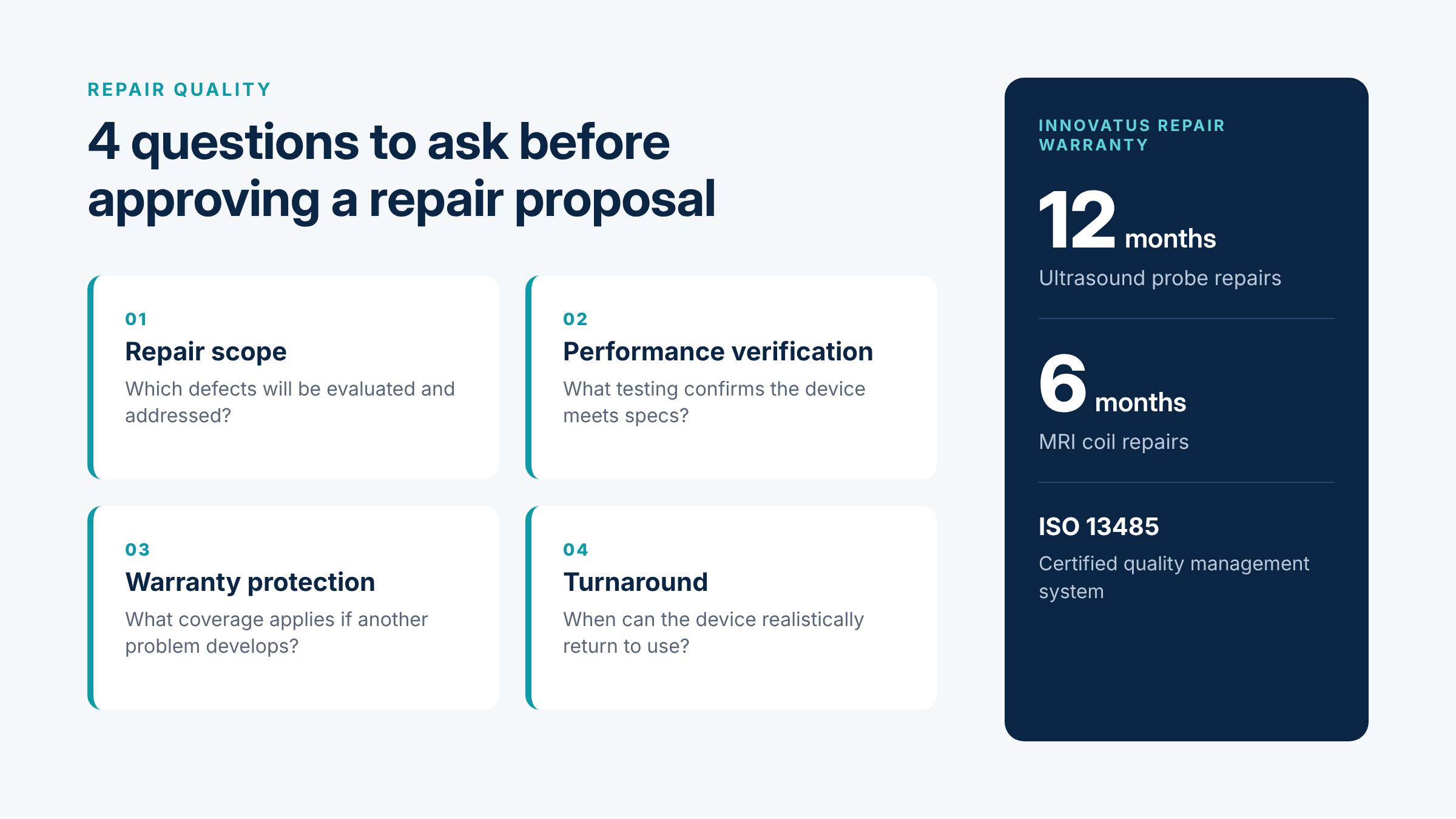
Innovatus also provides a 12-month warranty on all ultrasound probe repairs, and 6-months on MRI coil repairs.


When reviewing a repair proposal, administrators should confirm:

  • Repair scope: Which defects will be evaluated and addressed?
  • Performance verification: What testing confirms the device meets applicable specifications?
  • Warranty protection: What coverage applies if another problem develops?
  • Turnaround: When can the device realistically return to clinical use?
A graphic showing proposal questions

5. Repair Records as a Budgeting Tool

A device's repair history can reveal when continued repairs are becoming less economical.

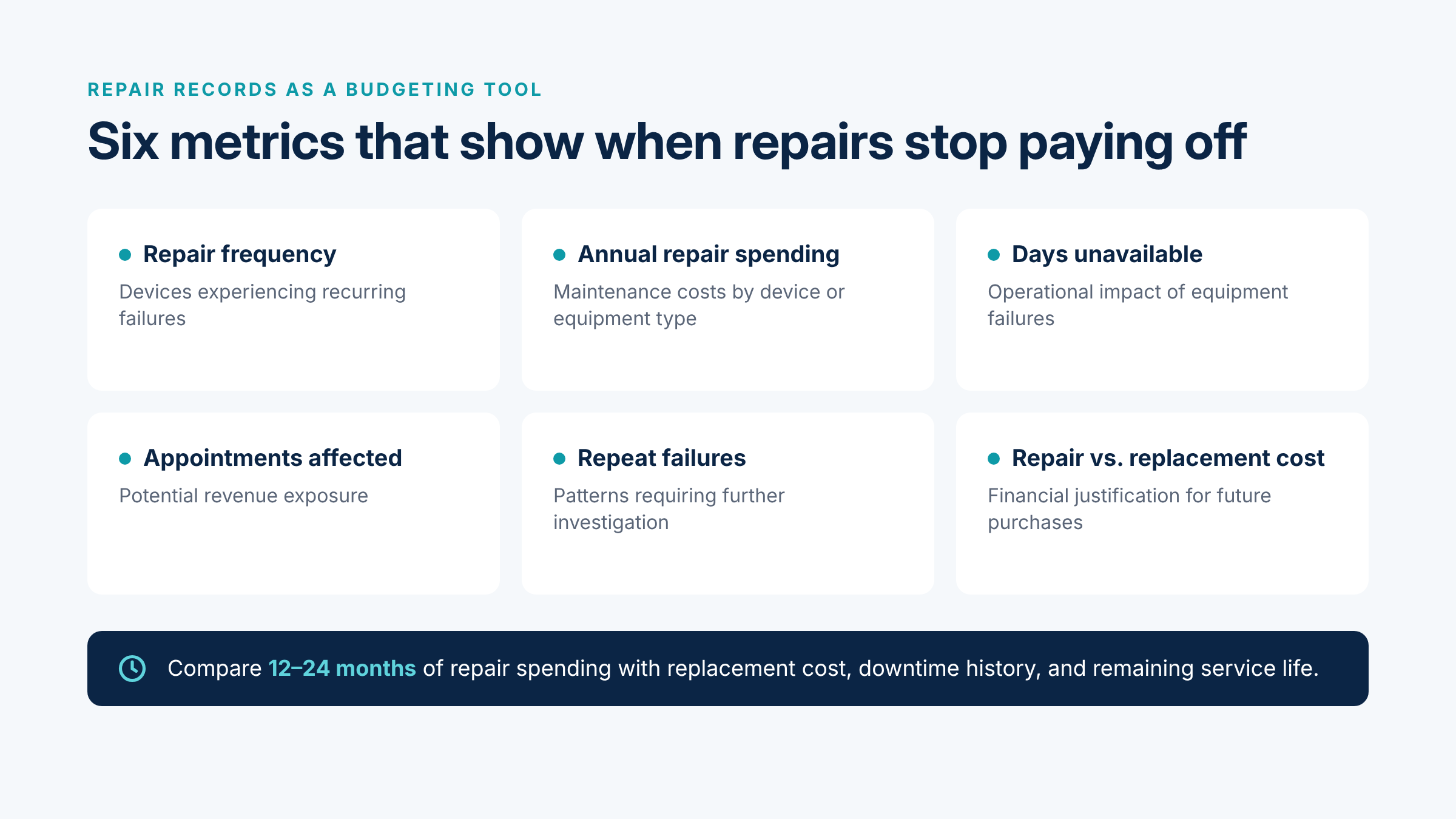
Tracking a few measures can help administrators distinguish between isolated failures, recurring problems, and devices approaching the end of their useful life.


  • Repair Frequency
  • Annual repair spending
  • Days available
  • Appointments affected
  • Repeat Failures
  • Repair vs. replacement cost
A graphic showing repair record metrics

When evaluating a device for replacement, compare its repair spending over the previous 12 to 24 months with its replacement cost, downtime history, and expected remaining service life. A single higher-cost repair may still be economical if the device has substantial remaining useful life. Repeated repairs, particularly when accompanied by downtime, may indicate that replacement deserves consideration.


Repeated cable damage across several ultrasound probes may indicate a need to review handling, transport, or storage practices. Frequent failures of a single device may warrant further engineering evaluation or replacement consideration.


Routine visual inspections, proper storage, and adherence to manufacturer handling and reprocessing instructions can help reduce avoidable damage.


Innovatus Imaging provides specialized ultrasound probe repair and MRI coil repair, comprehensive testing, and loaner and exchange programs that give independent imaging centers options beyond premature equipment replacement.


Need to evaluate a damaged ultrasound probe or MRI coil?


Start A Repair
(opens in a new tab)